How Spinal Decompression Can Help Support Disc Health
Most people think of spinal decompression as simply “stretching the back.”
But one of the more interesting benefits may be what happens inside the spinal disc itself.
Your Discs Need Nutrients Too
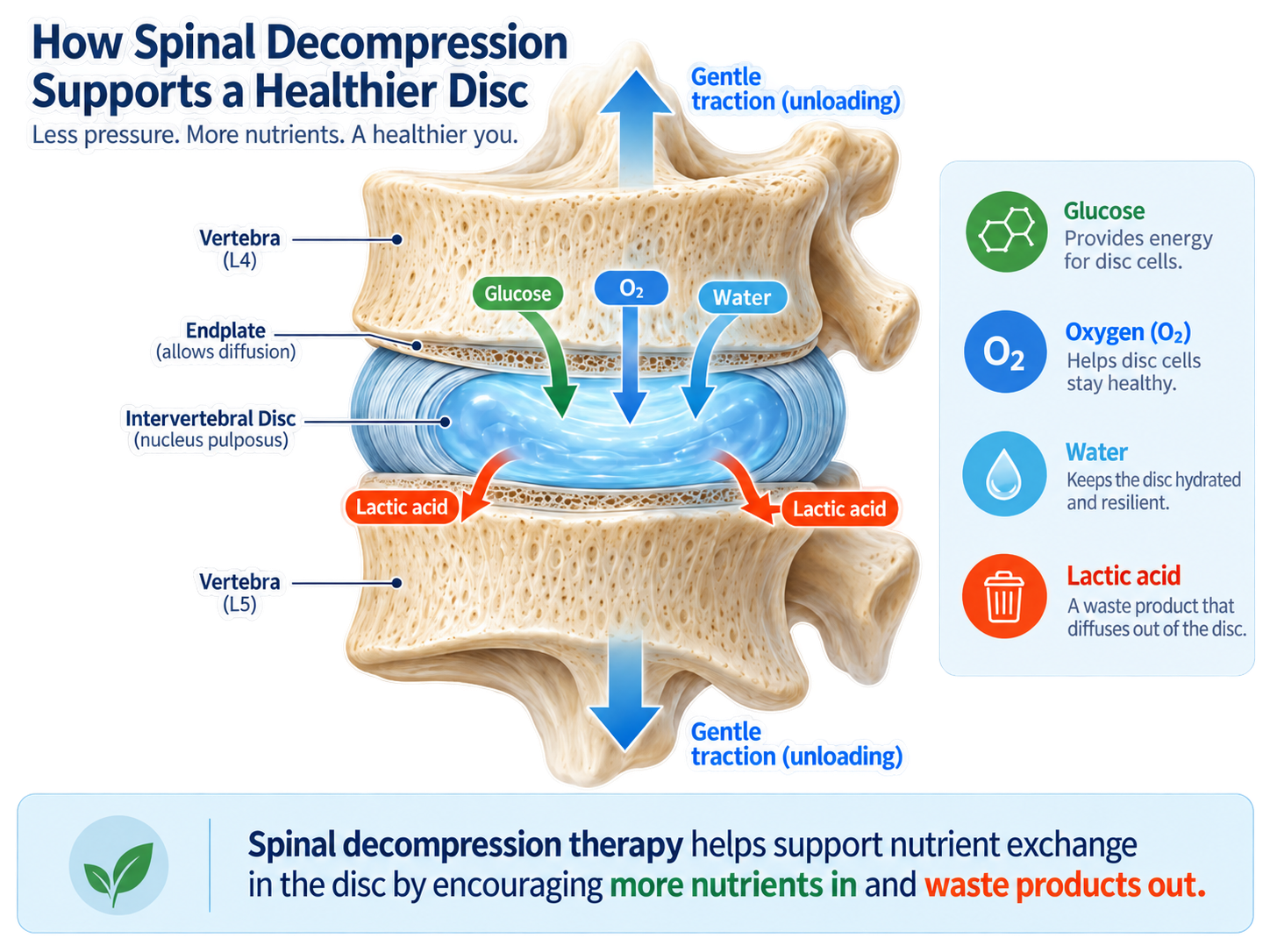
Spinal discs have very little direct blood supply. Instead, nutrients such as glucose, oxygen and water move into the disc largely through the vertebral endplates, while waste products such as lactic acid move out.
A simple way to think about it is like a sponge.
When a disc is compressed, fluid is pushed out. When pressure is reduced, fluid can move back in.
That normal cycle of loading and unloading appears to play an important role in maintaining a healthier environment inside the disc.
How Spinal Decompression Helps
Spinal decompression uses controlled distraction to temporarily reduce mechanical pressure through the spine.
At Spine Studio, we currently use the Back on Trac system, which allows gentle lumbar distraction without restrictive belts or harnesses.
The patient begins seated, the chair gradually reclines, and controlled stretching is applied through the lower back.
The goal is not simply to “pull the spine apart.” It is to create repeated periods of unloading that may help support normal fluid movement and nutrient exchange within the disc.
Research has shown that slow cyclic loading and unloading can increase the movement of molecules into the center of the disc, including in degenerative discs.
How Is This Different From an Inversion Table?
Inversion tables also reduce spinal loading, but the force is produced mainly by gravity and body weight.
Spinal decompression allows the amount and timing of distraction to be controlled while the patient remains supported and comfortable.
That makes the treatment easier to tailor to the individual patient.
Who Might Benefit?
Spinal decompression may be considered for certain people experiencing:
- Disc-related lower back pain
- Bulging or herniated discs
- Sciatica
- Radiating leg pain
- Degenerative disc changes
- Chronic lumbar stiffness
Not every back problem is appropriate for decompression, so evaluation is important.
Spinal Decompression in North Fort Worth and Keller, TX
Spine Studio provides spinal decompression therapy for patients in North Fort Worth, Keller and surrounding communities.
Our current office is located in North Fort Worth, and Spine Studio will be relocating to Keller, Texas. We are continuing to serve patients throughout both areas who are looking for non-surgical options for disc-related back pain and sciatica.
Less pressure. Better movement. A healthier environment for the disc.